
How blockchain tracing works: what it can show and what it cannot
Published: Last reviewed: Editorial policy
Blockchain tracing follows transfers on a public ledger from one address to the next. Analysts group addresses likely to belong to the same owner, label known services, and look for the point where funds reach an exchange or other service that holds customer identities. A trace can show where funds went. It cannot, by itself, prove who a person is or return the money.
Questions about your case? Message us:
A public ledger that shows movement, not names
Most major blockchains record every transfer in a public ledger. Anyone can see that an address sent a certain amount to another address at a certain time. Nobody has to give a name to create an address.
So a ledger is open but pseudonymous. You can follow the money in great detail, yet the ledger itself does not say who holds each address. Tracing is the work of closing that gap, as far as the evidence allows.
How analysts follow the funds
The basic step is to follow outputs. Starting from a known address, an analyst looks at where the funds went next, and then where they went after that. Software draws these hops as a graph, so a long chain can be read at a glance.
Tools used by analysts also record timing, amounts and patterns. A fast series of transfers in split amounts, for example, may suggest an effort to hide the path. The analyst notes such patterns but does not treat them as proof.
- Follow every transfer from the starting address through the following addresses.
- Note amounts, timestamps and the networks used, including cross chain bridges.
- Mark known services such as exchanges, payment processors and smart contracts.
- Record where the trail ends or becomes uncertain, and why.
Address clustering and labels
Clustering groups addresses that probably belong to the same owner. The groupings use heuristics, such as several addresses signing one transaction as inputs, or repeated reuse of a change address. These are educated guesses, not certainties.
Labels attach names to clusters, for example an exchange, a gambling site or a known scam wallet. Labels come from public sources, from direct knowledge of services and from reports. They can be wrong or out of date, which is why a careful report states how sure it is.
Mixers, bridges and other obstacles
Mixers pool funds from many users and send them out in new amounts, which breaks the simple link between input and output. Cross chain bridges and swaps move value to a different network, where the trail must be picked up again. Privacy focused coins and chain hopping add more steps.
These obstacles do not always end a trace. Analysts may still estimate links from timing and amounts. But a result after a mixer is usually a probability, not a fact, and a report should say so.
Exchanges as exit points
Regulated exchanges and other services collect identity documents from customers. If stolen or disputed funds reach a deposit address at such a service, that service holds the information about who controls the account. This is why exit points matter.
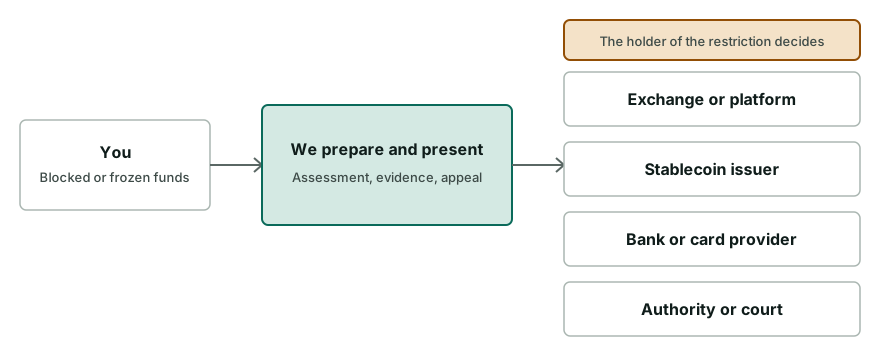
A trace can point to the service. The service then decides what to do, after a report from police, a court order or a valid request. It may freeze the account, ask for evidence or decline. We cannot force an exchange to act.
What a trace can and cannot show
A good trace can show the route of funds, the points where they changed hands, the services they touched and the time it took. It can support a report to police or a request to an exchange or issuer.
It cannot prove the identity of a person, the intent behind a transfer or that every link in the chain is certain. It cannot reverse a transfer. If you need a trace for a case, an independent analyst can prepare a report, and we can help you scope the request and use it with the right party.
Common questions
Can anyone trace my crypto transactions?
Anyone can read a public ledger, so transfers on those chains are visible. Linking an address to a real person takes extra information, such as exchange records or other data. Casual viewers see addresses, not names.
Can a trace find the scammer's identity?
Not by itself. A trace can lead to an exchange or another service that holds identity data. Police or a court then have to ask that service for it. The result depends on the service and the law that applies.
Does using a mixer make funds untraceable?
It makes tracing harder and less certain, but it does not always end it. Analysts can sometimes estimate links from timing and amounts. Such results are probabilities, and a report should explain how reliable they are.
How accurate are address labels?
They are useful but not perfect. Labels come from different sources and can be outdated or wrong. A careful analyst checks important labels against more than one source and states the level of confidence.
Will a tracing report return my funds?
No. A report is evidence. It can support a request to an exchange, an issuer or the police, but those parties decide what to do. No one can promise that funds will be returned.
How we can help
- Blockchain analytics report. A source-of-funds report from transaction tracing, ready for a compliance team.
- Stolen crypto tracing and freeze requests. Trace stolen crypto, send freeze requests to exchanges and issuers, file a police report.
- DeFi exploit and bridge hack response. Tracing, alerts and reporting after a DeFi exploit, bridge hack or malicious approval.
- Wallet screening and risk flag disputes. High-risk address flag from screening tools: document the path of funds and challenge it.
Information on this page is general and not legal advice.