
Crypto funds frozen or blocked? Find out who froze them and why
Published: Last reviewed: Editorial policy
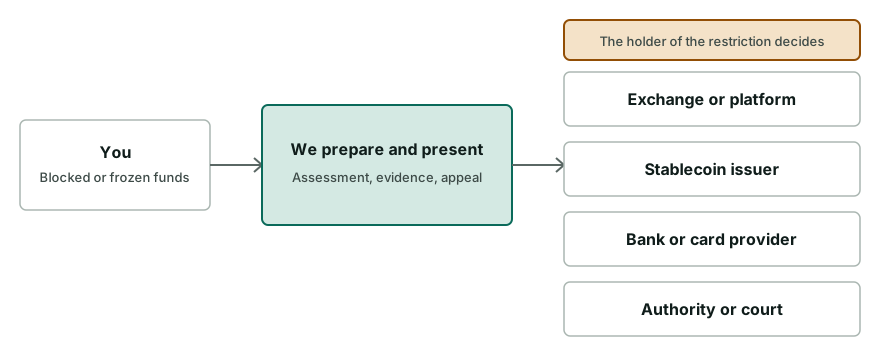
A frozen balance can mean very different things. A stablecoin issuer may have blacklisted an address. An exchange may be running a compliance review. A card or payment service may have set a limit. An authority may have placed a hold, or a screening tool may have flagged your funds. The right next step depends on who holds the restriction. We work that out first, tell you what is realistic, and point you to the right service. We cannot force any of them to release funds.
Questions about your case? Message us:
This is for you if
- You see a frozen balance, a failed transfer or a restriction notice and do not know who is behind it
- You received a vague message such as under review or temporarily limited
- Several parties are involved, such as an exchange, a wallet and a card, and you cannot tell which one acted
- You want an honest view before you pay anyone or contact anyone about recovery
Typical situations
- A stablecoin balance cannot be moved and the address may be blacklisted by the issuer
- An exchange account shows a withdrawal hold or a compliance review notice
- A crypto card or payment service declined payments or locked the account
- Funds disappeared into a hold after an authority contacted a platform
- A deposit was returned or held because the sending address was flagged by screening
- You cannot tell whether the cause is a freeze, a technical fault or a scam
What we do
- Collect the facts of what you can see
We ask for the messages, notices, ticket numbers, screenshots, addresses and transaction hashes you have. We build a dated timeline so that every statement later in the case rests on a fact, not a guess.
- Identify who controls the restriction
We separate the possible causes: a token issuer freeze, an exchange review, a card or payment service limit, a law enforcement hold or a sanctions flag. Each one has a different owner and a different route.
- Check whether it is a freeze at all
Some cases are not freezes. A transfer can fail from a network fee problem, a wrong address, a pending confirmation or a scam site. We rule these out early so you do not chase the wrong party.
- Tell you what can realistically be done
We give you a plain written view of the likely route, the evidence it would need and the limits. If we think there is no realistic route, we say so and do not take the case.
- Route you to the right service
Once the cause is clear, we point you to the matching service on this site, such as exchange unblocking, issuer appeals or legal support, and we explain what would be prepared.
How the case runs
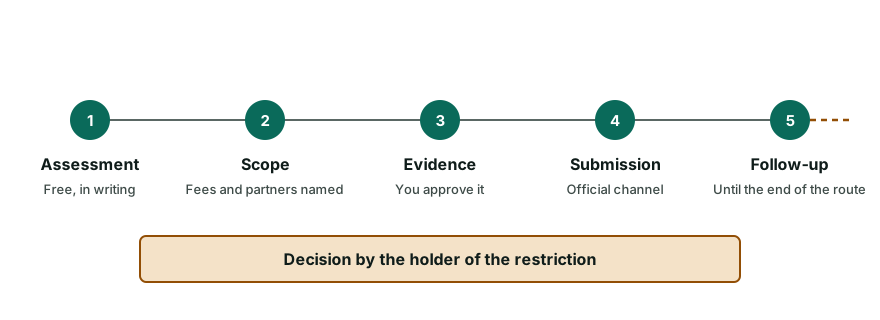
- Free assessment
You describe what you see and share what you have. We confirm in writing whether we can help, with no fee at this stage.
- Fact gathering
You send screenshots, addresses, hashes and messages through a secure channel. We check them for gaps and mismatches.
- Diagnosis
We state the most likely cause, who holds the restriction, and how confident we are. We also list what we do not know yet.
- Options in writing
You receive the realistic routes, the documents each would need and the fee model if you want us to continue.
- Hand-off or next step
We either continue under a written scope or tell you plainly that the case is outside what we can do.
What to prepare
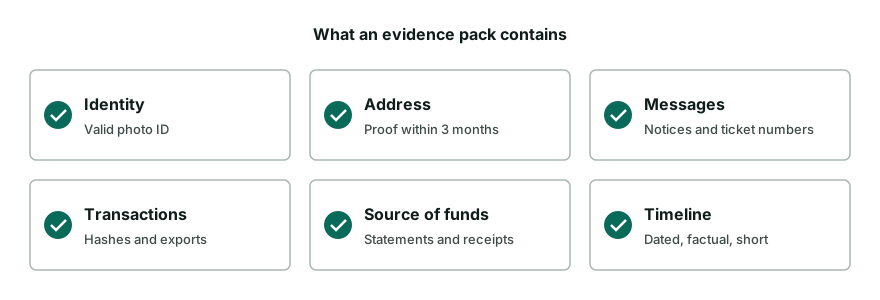
- Screenshots of every restriction notice, error message or support reply
- Ticket or case reference numbers from any platform you contacted
- Wallet addresses involved, labelled as yours or as a counterparty
- Transaction hashes for the last transfers before the problem started
- Account details of the exchange, card or payment service concerned, without passwords
- A short timeline of when the funds arrived and when the problem began
What we cannot do
- We cannot force an issuer, exchange, payment service or authority to lift a restriction. The decision-maker decides.
- A diagnosis is our reasoned view from the facts you provide. It is not a legal finding and some causes cannot be confirmed from outside.
- We do not promise a result or a timeline, and we do not take a case we believe has no realistic route.
- We will never ask for your seed phrase, private keys, passwords or remote access to your device.
How long it takes
A first diagnosis usually depends on how fast you can send the notices and addresses. We give an estimate after the assessment. Some causes cannot be confirmed until the platform answers.
Fees
The assessment is free. We tell you in writing whether we can help before any fee is discussed. If you continue, the scope and fee model are quoted in writing before you pay. Fees →
Questions people ask
How do I know who froze my crypto?
Look at where the funds sit and what the notice says. A token that will not move from a self-custody wallet points to the issuer. A locked balance on a platform points to that platform. We help you read the signs and confirm the likely owner of the restriction.
Is a frozen wallet the same as a frozen exchange account?
No. An exchange account is held by a company that can review it and lift limits. A wallet address you control cannot be frozen by the exchange, but a stablecoin issuer may be able to restrict the token at that address.
Could this be a scam rather than a freeze?
Yes, it can. Fake support messages and fake unlock fees are common. A real platform does not ask for your seed phrase or for a fee to your personal wallet. We check this early and tell you if the pattern looks like fraud.
What if more than one party is involved?
That is common. A card can be limited while an exchange account is also under review. We map each party separately, because each one decides on its own and needs its own answer.
Do I need to stop using my wallet or accounts?
Avoid moving funds in a hurry or sending test transfers to mixed addresses. Keep all messages and do not delete anything. If you are unsure whether an action could make things worse, ask us first.
Can you tell me my chances of getting the funds back?
Not as a percentage. Outcomes depend on the party that holds the restriction, the facts and the evidence. After diagnosis we can say whether a route looks realistic, doubtful or closed, and why.
Related situations
- Exchange account unblocking. Understand the freeze, prepare KYC/AML evidence, answer compliance and appeal.
- Stablecoin issuer appeals. Prepare a documented appeal to Tether, Circle or another stablecoin issuer.
- Crypto wallet unblocking. Frozen or flagged wallets: we prepare and present the case. Cases from USD 50,000.
- Crypto frozen by authorities. Assets held by authorities: we coordinate independent licensed lawyers. No legal advice.
Read next
Sources
Official or authoritative pages this page is based on. Pages change, so check the source for the current wording.
- Why is my account restricted? · Kraken
- Does Coinbase freeze accounts? · Coinbase
- How to Unlock My Binance Account? · Binance
Information on this page is general and not legal advice.