
Circle (USDC) blocked or frozen address: what the official pages say
Published: Official pages last read: Editorial policy
Circle says it can block an address from sending or receiving USDC in limited circumstances, mainly legal orders, urgent government requests or security threats, and that blocklisting is not a reversal of a completed transfer. It may remove an address when an authority lifts the order or the security issue ends. If funds were moved without consent, Circle advises contacting law enforcement first.
We are independent of Circle (USDC) and not affiliated with it. We cannot influence its decisions, and nothing on this page is an official statement of Circle (USDC).
Questions about your case? Message us:
What the platform's own pages say
- Circle's help article says it can block an individual blockchain address from sending or receiving USDC or EURC in certain limited circumstances, as explained in its Stablecoin Access Denial Policy. [1]
- The article says blocklisting, also called access denial or freezing, is different from reversing a transaction, and that USDC and EURC transactions are irreversible, so Circle cannot reverse or recall a completed transfer. [1]
- Listed circumstances include complying with laws and valid legal orders from a recognised US or French authority or court, responding to certain urgent government requests, and acting where Circle determines in its sole discretion that a security threat requires it. [1]
- The article says transfers to or from a blocked address may fail and that funds associated with the address may remain inaccessible while the blocklisting is in effect. [1]
- Circle says it may remove an address from the blocklist when the relevant authority formally confirms that a legal obligation or order has been lifted, or when a security incident no longer requires the restriction. [1]
- If funds were moved without your consent, the article says to contact local law enforcement as soon as possible with the sending and receiving addresses, the transaction hash, the date and time and the amount. [1]
- The article says law enforcement can provide valid legal process directly to Circle, which assesses it under its policy and applicable law. [1]
- Circle's v2.2 announcement says the blocklisting feature of its smart contracts lets Circle prevent specific addresses from sending and receiving USDC and EURC, and that the process follows its Access Denial policy. [2]
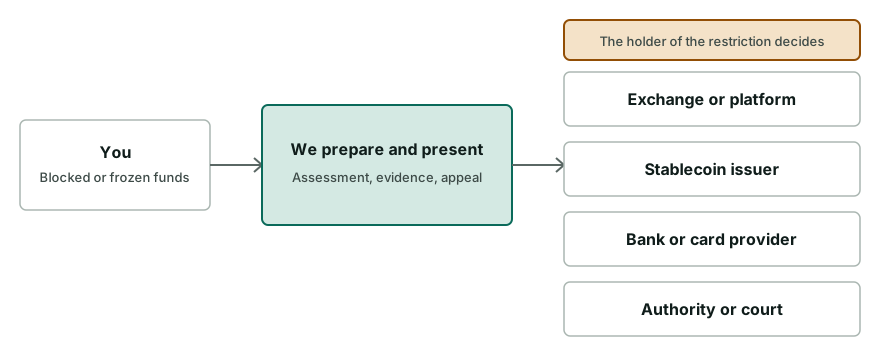
Typical restrictions
| Type of restriction | What it means |
|---|---|
| Address blocked by legal order | Circle lists compliance with laws and valid legal orders from a recognised authority or court among the reasons to block an address. Removal follows the authority confirming the order no longer applies. |
| Block after an urgent government request | Circle says it may act on certain urgent government requests. The article does not describe the request process, so the route is through the authority, not through the holder. |
| Block for a security threat | Circle says it may block an address where it determines, in its sole discretion, that this is necessary to prevent a threat to the security or reliability of its network. It may remove the block when the incident no longer requires it. |
| Funds stuck at a blocked address | Transfers to or from a blocked address may fail, and the funds may remain inaccessible while the block lasts. Circle says a block is not a reversal of a transfer. |
What you can do, step by step
- Confirm the address is actually blocked
A failed transfer can have other causes. Check the transaction details and ask your wallet or exchange whether the failure points to a block on the address.
- Find out why
Ask whoever notified you, such as a platform or an authority, whether a legal order, a government request or a security issue is behind it. Circle's article lists those as the main grounds.
- Collect evidence of ownership and origin
Prepare proof that you control the address and records that show where the funds came from. This is useful whichever party you deal with.
- Involve a lawyer where an order is involved
The article says a block follows legal obligations or orders and is removed when an authority confirms they no longer apply. A lawyer can approach the authority concerned.
- Report theft to law enforcement first
If funds were moved without your consent, Circle advises contacting local law enforcement as soon as possible with the addresses, hash, date, time and amount.
- Use Circle's support only through official pages
Circle's help page offers a contact route. Reach it through circle.com and never through links in messages from strangers.
What to prepare
- The blocked address and the token written as text
- Transaction hashes with dates, times and amounts
- Proof that you control the address
- Records that show where the funds came from
- Any notice or order you received from a platform or authority
- A police report number if funds were moved without your consent
Pitfalls and scams to avoid
- Never share your seed phrase, private keys or passwords with anyone who says they can get your address removed from a blocklist.
- Do not pay anyone who promises a quick removal. The article describes removal as a decision based on an authority or a closed security incident, not a service you can buy.
- Do not use sites that ask you to connect a wallet to check or unlock an address. They can drain your funds.
- Be careful with unsolicited messages offering to recover stolen USDC. Circle says a completed transfer cannot be reversed or recalled.
When outside help makes sense
- A legal order or investigation seems to be behind the block
- A large balance is stuck and the party that holds the restriction is unclear
- You need evidence of control and origin organised for an authority or lawyer
- Funds were stolen and you need the facts documented quickly for the police
Questions people ask
Why would Circle block my USDC address?
Circle's help article lists compliance with laws and valid legal orders, certain urgent government requests and a determination in its sole discretion that a security threat requires it. The article does not give details of how any single address is chosen.
Can Circle reverse a USDC transfer?
No. The article says USDC and EURC transactions are irreversible and Circle cannot reverse or recall a completed transfer. Blocklisting prevents an address from sending or receiving, which is a different thing.
Can a blocked address be unblocked?
The article says Circle may remove an address when the relevant authority formally confirms a legal obligation or order has been lifted or no longer applies, or when a security incident no longer requires the restriction.
What should I do if my USDC was stolen?
Circle's article advises contacting local law enforcement as soon as possible with the sending and receiving addresses, the transaction hash, the date and time and the amount. Law enforcement can then provide valid legal process to Circle.
Does Circle publish an appeal form for blocked addresses?
The help article describes the grounds and the removal conditions and offers a general contact route, but it describes no dedicated appeal form. For a block tied to a legal order, the authority and a lawyer are the usual route.
Does Circle have to tell me about a block?
The help article does not state a notification promise. If your platform told you about a block, ask what notice it received and from whom.
Is this page from Circle?
No. We are independent of Circle and not affiliated with it. We summarise Circle's own pages, link to them and cannot influence any decision about an address.
Related services
- Stablecoin issuer appeals. Prepare a documented appeal to Tether, Circle or another stablecoin issuer.
- Crypto wallet unblocking. Frozen or flagged wallets: we prepare and present the case. Cases from USD 50,000.
- Stolen crypto tracing and freeze requests. Trace stolen crypto, send freeze requests to exchanges and issuers, file a police report.
Read next
Official pages read
Official or authoritative pages this page is based on. Pages change, so check the source for the current wording.
- Understand Circle's stablecoin blocklisting process · Circle
- Announcing USDC v2.2 · Circle
Information on this page is general and not legal advice.