
Which documents an exchange compliance team asks for, and how to present them
Published: Last reviewed: Editorial policy
Exchange compliance teams usually ask for four groups of documents: a valid photo ID, proof of address, evidence of where the funds came from and proof that you control the wallet involved. Send clear, complete, recent files in one organised package, with a short cover note that links each document to the question asked. Never send passwords, seed phrases or unrelated private data.
Questions about your case? Message us:
Start with the question, not the folder
Before you collect anything, read the request again. The exchange tells you what it wants, sometimes in one line. A request to refresh your identity check needs different papers from a request to explain a large deposit.
Write the questions down as a list. Each document you prepare should answer one of them. If a question is unclear, ask the exchange to clarify it in writing before you send a large package.
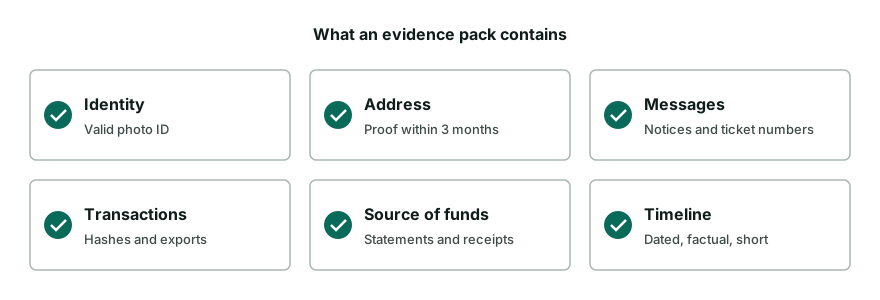
Identity and address documents
These are the simplest to prepare, and they are where many reviews fail on small details. Reviewers compare the name, the date of birth and the address across every file you send.
Use documents that are current and show the same spelling of your name as the account. If your name changed, add the document that proves it.
- Government photo ID that is valid and not expired, with all four corners visible.
- Proof of address dated within the last three months, such as a utility bill or bank statement, if the exchange asks for one.
- A clear selfie or live video check when requested, taken in good light without filters.
- Proof of a name change, such as a marriage certificate, if names differ between files.
- Company registration papers and a list of owners, when the account belongs to a business.
Source of funds documents
This is the group where reviews slow down. The exchange wants a paper trail from the origin of the money to the deposit that triggered the review. For the difference between source of funds and source of wealth, see our separate guide.
Choose documents that match the actual origin. A salary slip and a bank statement show a salary. An earlier exchange export and bank transfers show that funds came from trading. Where several origins mixed, show each part separately.
- Bank statements that show the transfer of money into the exchange or into the wallet.
- Exchange statements and transaction exports from earlier platforms.
- Sale contracts, invoices or payment receipts for goods, services or property.
- Tax returns or payslips when the funds come from income.
- A written explanation for anything the papers do not cover.
Proof that you control the wallet
When the review involves a self custody wallet, the exchange may ask you to show that the address is yours. This can be done without exposing any secret.
The usual methods are a signed message from the address, a small test transfer with an agreed amount or a screenshot of the wallet showing the address in a live session. Choose the method the exchange accepts. Never reveal your keys.
Format and presentation tips
A tidy package signals a reliable customer. A messy one invites follow up questions and delays. Use one file per document, in PDF where possible, with clear names such as bank-statement-2026-03.pdf.
Add a one page cover note listing the files and saying which question each one answers. Keep your tone factual and short. Do not argue, threaten or complain in the same message.
- Scan or photograph in colour, in full, with no cropped edges and no glare.
- Do not edit, retouch or redact anything the exchange has not allowed you to hide.
- Keep file sizes within the upload limit instead of splitting a statement across many images.
- Send everything through the channel named in the ticket and keep the reference number.
- Keep copies of what you sent and the date you sent it.
What not to send
More is not better. Extra private data creates risk for you and noise for the reviewer. Do not send anything that the request did not ask for, unless it directly explains a point.
Never send a seed phrase, a private key, a wallet password, a one time code or remote access to your computer. No genuine compliance team needs them. Do not send documents that you have altered or that belong to someone else without their agreement.
Common questions
How recent must a proof of address be?
Many exchanges ask for a document dated within the last three months, but the rule differs by platform. Check the wording of the request. If it gives no period, send the newest document you have.
Can I black out parts of a bank statement?
Only if the exchange allows it. Usually you may hide unrelated transactions, but your name, the account number or IBAN, the date range and the relevant lines must stay visible. Ask first, because an altered looking file can be rejected.
What if I do not have documents for an old transaction?
Say so openly and offer the closest alternative evidence, such as an old exchange export, a bank record or a signed statement from the other party. A clear explanation is better than an invented document.
Should I send all documents at once or step by step?
Send one complete package that answers every question in the request. Repeated partial replies create confusion and can restart review timers. If part of the request cannot be met, explain that in the cover note.
Do I need to translate my documents?
Often yes, if they are not in a language the exchange accepts. Ask whether a plain translation is enough or whether a sworn translation is required. Send the original file next to the translation.
How we can help
- Source of funds and source of wealth packs. Build a clear source of funds and source of wealth pack for exchanges, banks and processors.
- Exchange account unblocking. Understand the freeze, prepare KYC/AML evidence, answer compliance and appeal.
- Crypto freeze diagnosis. Work out who froze your funds and what can realistically be done next.
- Wallet screening and risk flag disputes. High-risk address flag from screening tools: document the path of funds and challenge it.
Information on this page is general and not legal advice.