
USDC address blocked: how a Circle blacklist works and what to do next
Published: Last reviewed: Editorial policy
A USDC address can be placed on the issuer's blocklist, which stops the tokens from being transferred while the balance still shows on-chain. Circle is the party that controls this. Causes include a legal order, sanctions screening and risk flags. Wallets, exchanges and block explorers cannot reverse it. The practical route is a documented request to the issuer, usually with a lawyer's help.
Questions about your case? Message us:
Signs that the block is on the address, not the app
Your wallet shows a USDC balance, but every send fails. Swaps through decentralised services fail as well. Other tokens in the same wallet work normally. That pattern points to a restriction on the USDC contract, not to a problem with your wallet app.
Before you assume a blacklist, rule out ordinary causes. A wrong network, no gas in the wallet and a congested network all produce failed sends.
- Send a small amount of another token from the same address. If it works, the wallet is fine.
- Look at the failed transaction on the explorer and read the error text.
- Check the USDC contract page for the address in its blocklist events, where the chain data allows it.
- Save screenshots with date and time.
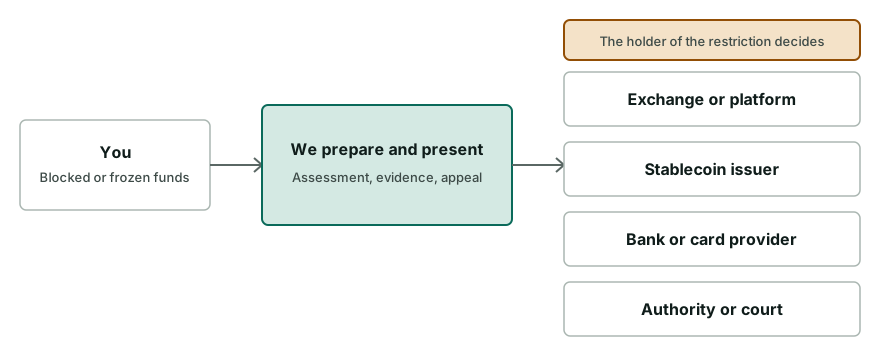
How issuer blacklisting works in general
USDC is a regulated, centrally issued stablecoin. The contract includes a function that lets the issuer add an address to a blocklist. Once added, that address cannot send or receive the token on that network.
This is a design feature of fiat backed stablecoins, not a bug and not a hack. It exists so that the issuer can respond to legal orders and sanctions rules. It also means that a decision made in one office can freeze funds held in a wallet you control alone.
What usually triggers a blocklisting
The issuer rarely explains each decision. From public discussion, the triggers fall into a few groups. Treat this list as a map of possibilities, not a diagnosis of your case.
- A court order or an instruction from a public authority tied to an investigation.
- Sanctions screening, where an address is linked to a listed person or service.
- Exposure to addresses connected to fraud, theft or hacks, found by blockchain analytics.
- A request from a partner exchange or a financial institution that handles the token.
Who decides, and what they look at
The decision belongs to the issuer, and sometimes to the authority behind a request. Neither will usually discuss the case with a third party who has no mandate from you.
A review typically looks at where the funds came from, who held them before you and whether you can show a clear commercial or personal reason for each transfer. Gaps in that story are what slow a case down. Evidence for the legitimate origin of the funds is the strongest thing you can bring.
Steps that are open to you
The main route is a written request to the issuer, sent through its official legal or support channel, with your identity, the address, the dates and the evidence of origin. If an authority is involved, the request may need to go through a lawyer in that jurisdiction.
Outcomes vary. The address may be released, stay blocked, or the issuer may say that only a court can decide. We cannot promise any of these results, and we cannot make the issuer act.
- Prepare a timeline of how the USDC arrived at the address.
- Collect proof: exchange statements, bank transfers, invoices, contracts.
- Prove control of the address in a way that does not reveal your keys, for example a signed message.
- Send one complete request instead of many partial ones.
- Never share a seed phrase, private key or password with anyone.
What to avoid while you wait
Do not send test transfers from flagged funds to new addresses, and do not try to mix or bridge what you still control. Those moves create new questions and can look like an attempt to hide the origin.
Be wary of messages that claim a connection with the issuer, or offers to remove the address from a blocklist for a fee. If you want a second opinion on your documents before you write to the issuer, we offer a free assessment and can bring in independent lawyers.
Common questions
Can an exchange release my blocked USDC?
No. An exchange cannot override a restriction in the token contract. It can only decide what it does with funds on its own platform. The party that can change the status of the address is the issuer.
Is a Circle blocklisting permanent?
We cannot say. Some restrictions are removed after a review, others stay while a legal matter is open. The issuer or a court sets the outcome, so ask the issuer what applies to your address.
Will the issuer tell me why my address was blocked?
Often only in general terms, and sometimes not at all, especially when an authority asked for the block. A lawyer may get more detail through a formal request than a private person can.
Can I receive new USDC on the blocked address?
Usually not. A blocklisted address is restricted for both sending and receiving. Do not ask others to send funds there, because they may be stuck as well.
Do I need a lawyer to contact the issuer?
Not always. A private request with good evidence can be enough in simple cases. A lawyer helps when a large amount is involved, when an authority is behind the block or when your first request is ignored.
How we can help
- Stablecoin issuer appeals. Prepare a documented appeal to Tether, Circle or another stablecoin issuer.
- Crypto wallet unblocking. Frozen or flagged wallets: we prepare and present the case. Cases from USD 50,000.
- Blockchain analytics report. A source-of-funds report from transaction tracing, ready for a compliance team.
- Sanctions and AML false positive support. Wrong sanctions or AML match: evidence pack and a lawyer-filed statement to remove the flag.
Information on this page is general and not legal advice.