
Blockchain analytics report: trace the origin of your funds for compliance
Published: Last reviewed: Editorial policy
A blockchain analytics report traces how funds reached an address: which transfers, through which counterparties, with which risk flags. Independent specialists prepare it from public ledger data, and we turn it into a clear document a compliance team can read. It can show the path of funds. It cannot prove who owned an address, why a payment was made, or that a platform must accept it.
Questions about your case? Message us:
This is for you if
- A compliance team asked where your crypto came from and your own records are incomplete
- Your funds arrived through several hops and you need the path laid out clearly
- A platform flagged a deposit and you want to see what its screening probably saw
- A lawyer or accountant needs a neutral summary of the on-chain history
- You want to check an address before you accept a large transfer
Typical situations
- An exchange requests source of funds for a large deposit
- Funds were bought on the market, moved between your wallets and then flagged
- You received a payment and later learned the sender address had a risk label
- A bank questions the origin of money that came from a crypto sale
- An old wallet balance needs an explained history before it can be used
- You need an evidence exhibit for a dispute or an appeal
What we do
- Define the question the report must answer
We agree the exact question first: origin of one deposit, history of one wallet or exposure to a flagged counterparty. A narrow, clear question produces a document a reviewer can use.
- Have independent specialists trace the transactions
Independent blockchain analysts follow the transfers on the public ledger, label the counterparties they can identify and record the hops. We select them, brief them and check that the scope matches your question.
- Mark risk flags and explain them
The report lists any exposure to categories such as exchanges, mixers, sanctioned entities or scam-linked addresses. Each flag is explained in plain words, with the transfers that caused it.
- Match the chain to your own records
Ledger data alone is thin. We link the traced transfers to your bank statements, receipts and exchange exports, so the report tells one consistent story instead of a list of hashes.
- Deliver a document for the reviewer
You receive a structured report with a summary, a path of funds, a table of transfers and a short note on method and limits. You decide whether to submit it to the platform or lawyer.
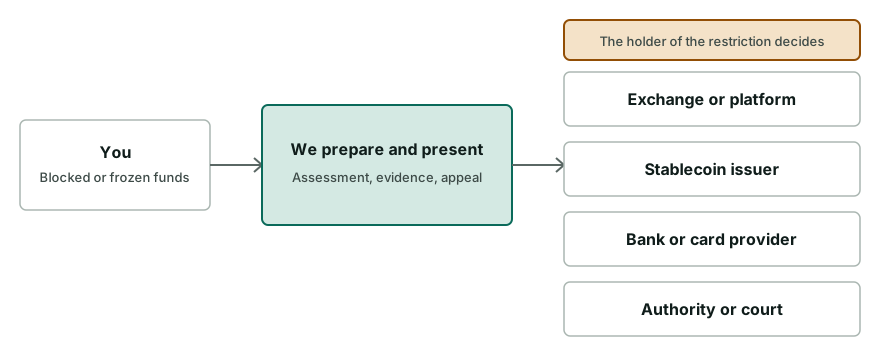
How the case runs
- Free assessment
You explain who asked what and why. We tell you in writing whether a report would help and what it would need.
- Written scope and fee
You receive the question, the addresses in scope, the specialists involved and the fee model before you pay anything.
- Tracing
The specialists trace the transfers and label counterparties. We review the draft for gaps and for statements the data cannot support.
- Reconciliation
We compare the chain history with your own documents and ask you about any mismatch before the report is finalised.
- Delivery and use
You receive the final report and a short guide on how to present it. We can help you send it to the platform or counsel.
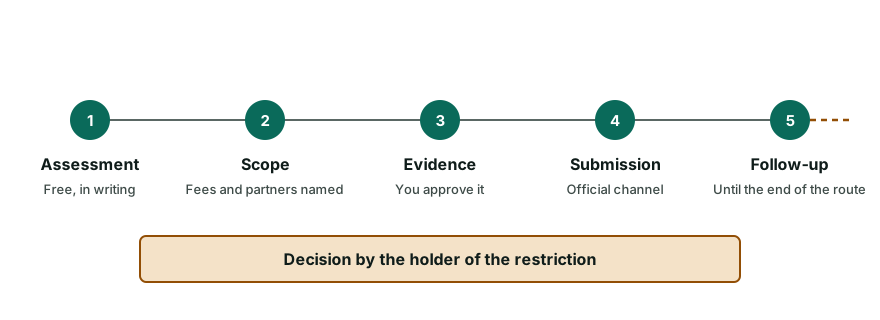
What to prepare
- The wallet addresses in scope and which of them you control
- Transaction hashes or dates and amounts of the transfers you care about
- The exact question or request from the platform, bank or lawyer
- Exchange exports and trade history for the period
- Bank statements or receipts showing how the funds were first bought
- Any earlier report, risk score or screening result you were shown
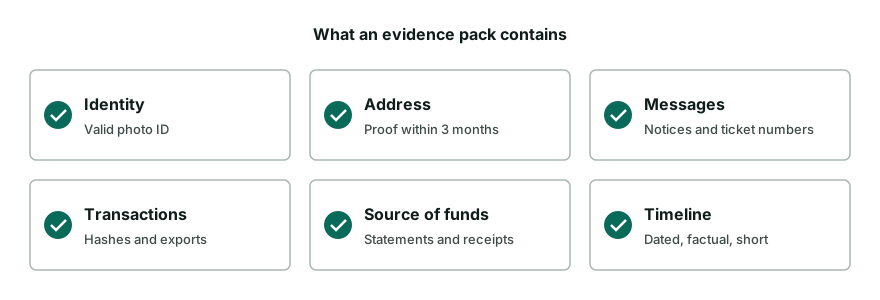
What we cannot do
- A report shows the path of funds on the public ledger. It does not prove who owns an address, the purpose of a payment or that the funds are clean.
- Labels on counterparties come from analytics data and can be incomplete or wrong. We state the confidence level and the basis.
- A platform is free to ignore a report. We cannot force a compliance team, issuer or authority to accept it or to change its decision.
- Privacy tools, cross-chain bridges and off-chain trades can break the trace. The report says where the trail stops.
- We never ask for your seed phrase, private keys or passwords. Tracing only needs public addresses.
How long it takes
Time depends on the number of addresses, the depth of the trace and how fast you can supply matching records. We give an estimate after the assessment.
Fees
The assessment is free. Report fees depend on scope and complexity and are quoted in writing before you pay. No fee is requested before we say whether a report would help. Fees →
Questions people ask
What does a source-of-funds report from blockchain analysis include?
It includes a summary, a path of funds from the earliest identifiable source to your address, a table of transfers, labelled counterparties, risk flags with explanations and a note on method and limits. It is written for a compliance reader, not for a technical audience.
Can a blockchain report prove my funds are legitimate?
No. It shows where the funds moved and what labels the counterparties carry. Legitimacy also depends on how you earned or bought the money, which is why we pair the report with your bank and purchase records.
Will an exchange accept this report?
Some compliance teams find it useful, others use their own tools and only read it as context. We cannot promise acceptance. A clear report with matching documents usually helps more than raw transaction lists.
Do you need access to my wallet?
No. Tracing uses public addresses and transaction hashes. Never send a seed phrase, private key or password to anyone offering a report. A genuine analyst does not need them.
What if the trace goes through a mixer or a bridge?
The report will mark the point where the trail becomes uncertain and explain what is known on each side. Some bridges can be followed, mixers usually cannot. We state the limit rather than guess.
Is this the same as a risk score?
No. A risk score is a single number from a screening tool. A report explains the transfers behind it. It can help you challenge a score that does not match the real history.
Related situations
- Crypto freeze diagnosis. Work out who froze your funds and what can realistically be done next.
- Source of funds and source of wealth packs. Build a clear source of funds and source of wealth pack for exchanges, banks and processors.
- Wallet screening and risk flag disputes. High-risk address flag from screening tools: document the path of funds and challenge it.
- Stolen crypto tracing and freeze requests. Trace stolen crypto, send freeze requests to exchanges and issuers, file a police report.
Read next
Information on this page is general and not legal advice.