How to share documents with a crypto recovery service safely, and what to keep to yourself
Published: Last reviewed: Editorial policy
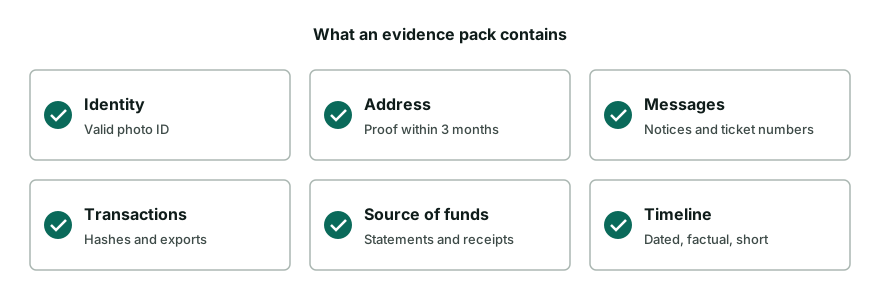
Share in stages. For a first assessment, a short written account plus public details such as transaction hashes, wallet addresses and dates is enough. Send statements and identity documents only after you have checked who you are dealing with and agreed a written scope. Never share a seed phrase, a private key, a password, a one-time code or remote access to your device, whoever asks and whatever reason they give.
Questions about your case? Message us:
Share in stages, not all at once
People who lose crypto get asked for documents by exchanges, banks, police, lawyers and recovery services. Fraudsters know this. Some fake services exist only to collect identity papers, wallet access or both.
A genuine provider needs facts about what happened. It does not need the secrets that control your wallet. If you share in stages and check each party first, you give a real provider what it needs and a fake one very little.
| Stage | What you may share | Condition |
|---|---|---|
| 1. First assessment | A short written account, platform names, dates, amounts, transaction hashes and public wallet addresses | A basic check that the party exists. Identity documents are not usually needed yet. |
| 2. After you agree a written scope | Redacted statements, chat exports, screenshots, notices and the police report number | You have verified the party and read the scope, the fee model and who will see the files. |
| 3. When a filing needs it | Identity and address documents, proof of ownership and signed forms | A named recipient, a stated purpose and a secure channel. Where possible, give identity documents directly to the platform or authority that needs them. |
| Never, at any stage | Seed phrase, private keys, passwords, one-time codes, remote access | No reason makes it safe. A request for any of them is a warning sign. |
What you should never share
These items give control, not information. Whoever holds them can move your funds or take over your accounts. No honest assessment, trace or filing needs them, so a request for any of them is a warning sign.
- Your seed phrase or recovery phrase, or a photo of it.
- Private keys, including exported key files and the keys inside a wallet app.
- Passwords and PINs for wallets, exchanges, email, banking and your phone.
- One-time codes, authenticator codes and backup codes.
- Remote access to your computer or phone, including screen-sharing sessions.
- API keys that can trade or withdraw, and full card numbers with the security code.
- A screenshot or scan of any of the above. Check each image for a corner of the screen that shows a code or a phrase.
Redact before you send
Redaction means hiding details that the next step does not need. It limits the damage if a file is ever leaked. Hide the detail properly, because a black box drawn over text in an editable PDF can leave the text underneath, and anyone can copy it out.
Use a tool that removes the text, or print the page to a new PDF, or take a screenshot of the redacted result and send that. Remove hidden file details too. Photos and documents can carry data such as dates, device names and locations.
- Hide ID numbers the request does not need, full card numbers, unrelated transactions on a statement and the names of people who are not part of the case.
- Keep visible your name, the account or wallet identifiers that matter, dates, amounts and the lines that prove the point.
- Label the copy as redacted, and keep the unredacted original. Never change a number or a date.
- Add a visible note on identity copies, such as the recipient's name and the date, so the copy is harder to reuse.
- If a platform, police unit or court asks for unredacted files, give them to that body directly where you can.
Choose a safe way to send files
Use the channel the party names, and make sure its name came from a source you trust, such as their website that you typed in yourself, not a link in a message. Avoid social media chats, public group chats and open share links.
- Prefer an upload portal on a site you opened yourself, or end-to-end encrypted messaging or email.
- If you use a shared folder link, set an expiry and a password, and turn off public access.
- Protect an archive with a strong password, and send the password by a different channel, such as a call you place yourself.
- Do not send from a device you think is infected, and avoid public Wi-Fi while you send.
- Keep a list of what you sent, when, to whom and how.
- Ask in writing how long the party keeps your files and how it deletes them after the case.
How to verify who you are dealing with
Check the party before you send anything beyond stage one. A real firm expects the checks and answers them in writing. Our guide on spotting recovery scams gives a longer checklist, and it applies to us as well.
- The full legal name, registration number and address, checked in the official company register for that country.
- Who exactly will see your documents: staff, independent lawyers, independent specialists. Ask for names and roles in the scope.
- Whether any lawyer is licensed, checked with the bar or legal register yourself, not through a link they send.
- Whether they contacted you first. A cold contact after a loss is the most common warning sign.
- Whether they ask for money, access or secrets before they have said what they will do.
What a fair confidentiality promise looks like
Any provider can say that your data is safe. A fair promise is specific, in writing and honest about its limits. It tells you what is covered, who may see it, what it is used for, how long it is kept and how you can have it deleted.
On our side, the written scope names who will see your documents, and you approve every document before it is sent. Ask any provider for the same in writing.
| Point | A fair promise says | A warning sign |
|---|---|---|
| What is covered | All documents and facts you give, in any form | A promise that covers only 'sensitive' items, left undefined |
| Who may see it | Named staff and named independent partners who need it, each bound in writing | 'Trusted third parties' with no names or roles |
| Purpose | Used only to assess and handle your case | Use for marketing, data sales or other clients' files |
| Storage and deletion | A stated retention period and deletion on request, unless the law requires keeping the files | No retention terms, or a refusal to delete |
| Disclosure | Shared with authorities only when the law requires it, and you are told where the law allows | A promise of absolute secrecy that nobody can keep |
| Approval | You approve what goes to each recipient | Documents forwarded without asking you |
If you have already shared too much
It happens to careful people, and it can be handled. Act in the order below, and write down what you did and when. If you want help sorting out the evidence afterwards, ask us for a free assessment. We say in writing whether we can help, and we never ask for your secrets.
- Seed phrase or private key shared: treat the wallet as compromised. Set up a fresh wallet on a clean device and move your remaining funds into it.
- Password or code shared: change the password at once, sign out of all sessions and replace your two-factor method.
- Remote access given: disconnect, uninstall the tool, run a security scan and change your passwords from a different device.
- Identity documents sent to an unverified party: tell your bank, ask about fraud alerts or credit monitoring where you live, and watch for new accounts in your name.
- Tell the police or the national cybercrime service what happened, and note down the reference they give you.
Common questions
Do I need to send my passport to get a free assessment?
Usually not. A short written account and public details such as transaction hashes, wallet addresses and dates are enough for a first view. Identity documents come later, if a filing needs them, and they are safer sent straight to the platform or authority that asks for them.
Is it safe to send screenshots of my exchange account?
Yes, if you check each image first. Make sure it shows no one-time code, API key, recovery phrase or full card number, and hide details the next step does not need. Keep the original screenshots, because a reviewer may ask for them later.
A service asked to connect to my computer to check my wallet. Should I allow it?
No. Remote access gives the other person control of your device, your accounts and anything open on screen. An honest assessment, trace or filing does not need it. Treat the request as a scam and end the contact.
How long should a recovery service keep my documents?
There is no single rule, and the law in some places sets retention periods. Ask for the period in writing, and ask how your files are deleted when the case ends. A provider that cannot answer is not ready to hold your data.
Can a provider promise that nobody else will ever see my documents?
No honest provider can. It may have to share files with named lawyers or specialists to do the work, and the law can require disclosure to authorities or courts. A fair promise names those limits and asks for your approval before files go anywhere.
How we can help
- Digital evidence preparation for crypto cases. Capture, log and organise chats, screenshots and records so police, platforms or lawyers can use them.
- Crypto scam recovery support. Calm help after a crypto scam: assess, document, trace and send freeze requests.
- Wallet password and file recovery. Forgotten password or damaged wallet file: vetted independent specialists try recovery.
- Stolen crypto tracing and freeze requests. Trace stolen crypto, send freeze requests to exchanges and issuers, file a police report.
Information on this page is general and not legal advice.