
Source of funds vs source of wealth: the difference and how to prove each
Published: Last reviewed: Editorial policy
Source of funds answers one question: where did the money used in this transaction come from? Source of wealth answers a wider one: how did you build your overall assets over time? Exchanges ask for the first on a specific deposit and for the second on large or high risk accounts. Each needs documents that match the actual origin.
Questions about your case? Message us:
Two questions that sound alike
Source of funds is narrow. It is about the money in a particular transfer, such as the deposit that triggered a review. The reviewer wants to see the path from the origin of that money to the exchange.
Source of wealth is broad. It describes how your total assets came to exist, such as years of employment, a business, an inheritance or investment profits. It gives context, so the reviewer can judge whether the size of the deposit fits your story.
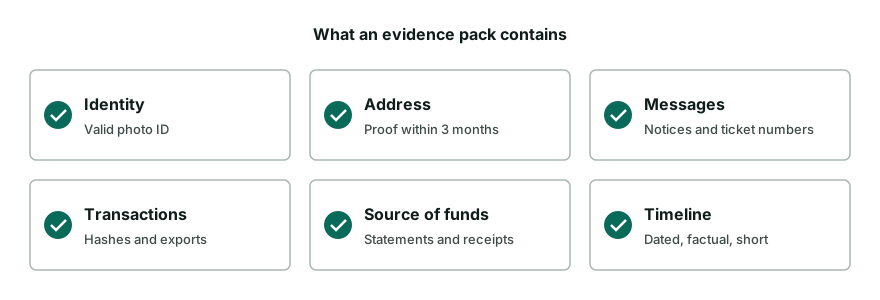
Why exchanges ask for one or the other
A request for source of funds usually follows a specific event: a large deposit, a transfer from an unfamiliar address or a flagged counterparty. A request for source of wealth appears when the account is large, the profile is high risk or the activity looks far above the declared income.
Some requests ask for both. Answer each in its own section, so the reviewer can tick it off without searching.
Examples by origin and the evidence that fits
The right evidence depends on the origin. A document that proves one origin may prove nothing for another. Use the following as a starting point and adjust to your own case.
- Salary: payslips, an employment contract and bank statements that show the salary arriving and the transfer to the exchange.
- Trading profits: exchange exports and statements from the platforms where you traded, with the withdrawal records that lead to the current deposit.
- Mining: records of the mining setup, pool payout history and the wallet addresses that received payouts.
- Sale of property or a vehicle: the sale contract, the proof of payment and the bank record of the proceeds.
- Gift: a signed gift letter with the donor's details, proof of the donor's funds if asked, and the bank record of the transfer.
- Inheritance: a will or court document, proof of the estate's value and the record of the payment to you.
Linking the documents into a story
A pile of files is hard to read. A short narrative makes it easy. Write three or four sentences for each origin: what the money was, when it arrived, how it moved and which file proves each step.
Where funds passed through several wallets or platforms, list the hops in order with dates and amounts. The numbers in your story must match the numbers in your documents. Mismatches are the most common reason a response is rejected.
Common gaps and how to handle them
Real life is messy. You may have cash savings, funds from a friend, an old account that was closed or documents in another language. These gaps are not fatal if you explain them honestly.
Offer the closest available substitute and say why the original is missing. A signed statement from a counterparty, a notarised letter or an official copy requested from a bank can fill a hole. Do not invent or alter a document. A false paper is worse than a missing one.
- Request old statements from your bank or platform, since many keep records for several years.
- Translate documents that are not in the language the exchange uses.
- Keep amounts in the original currency and add the conversion date and rate.
- Explain cash origin with savings history, not just with a statement of intent.
What to do next
Read your request again and mark which of the two questions it asks. Then build one file per origin and a short cover note that follows the order of the questions.
If you are unsure how to present a mixed origin, or an earlier answer was rejected, we can review your documents for free and tell you where the gaps are. We prepare the package with you and coordinate independent specialists where needed. The exchange makes the final decision.
Common questions
Is source of funds the same as source of wealth?
No. Source of funds covers where the money in a specific transaction came from. Source of wealth covers how your overall assets were built. A reviewer may ask for one or both, and each needs its own explanation and documents.
Do I need a tax return to prove my source of wealth?
Not always, but it is strong evidence for income from work or a business. Other papers can also show wealth, such as payslips, sale contracts and bank statements. Use what fits the origin you describe.
Can I use a gift as a source of funds?
Yes, if you can document it. A signed letter from the donor, the donor's identity details and the bank record of the transfer are typical. Some exchanges also want evidence of how the donor obtained the money.
What if my funds came from earlier crypto gains?
Show the chain: the original purchase with fiat, the trading history, and the withdrawals that lead to the current deposit. Platform exports and bank records are the usual proof. Gaps in the chain should be explained, not skipped.
How far back do I need to go?
As far as it takes to reach a clear, documented origin. For many cases that is a few years. The exchange may name a period. If it does not, ask which time frame it expects.
How we can help
- Source of funds and source of wealth packs. Build a clear source of funds and source of wealth pack for exchanges, banks and processors.
- Exchange account unblocking. Understand the freeze, prepare KYC/AML evidence, answer compliance and appeal.
- Sanctions and AML false positive support. Wrong sanctions or AML match: evidence pack and a lawyer-filed statement to remove the flag.
- Crypto freeze diagnosis. Work out who froze your funds and what can realistically be done next.
Information on this page is general and not legal advice.