
Where to report a crypto scam: official channels in eight countries
Published: Last reviewed: Editorial policy
Report a crypto scam to the police or national fraud service of the country where you live, and tell your bank and the exchange the same day. In the US that is the FBI's IC3, in the UK Report Fraud, in Canada the Canadian Anti-Fraud Centre and in Australia Scamwatch and ReportCyber. Taking a report is normally free. Channels change, so check the official page before you file.
Questions about your case? Message us:
Before you report: what to do and what to collect
The first steps are the same in every country, and they make any report stronger. Stop paying, even if someone says one last fee will release your funds. Call your bank or card provider and the exchange you used, because funds that are still with them are the ones they may be able to act on. Then gather the items below and find your country in the table.
- The wallet addresses that received your funds, the coin, the amount, and the date and time of each transfer.
- The transaction hash for every transfer.
- How the scammer first made contact, and the apps, websites, phone numbers and domains they used.
- The exchanges and banks your money passed through.
- Screenshots of chats, profiles, websites and any balance or fee demand.
- A short timeline from first contact to the last payment.
Official reporting channels in eight countries
The table shows the main official channel for each country, what to have ready and a note that matters. It is a starting point, not legal advice. Channels, names and phone numbers change, so open the official page, linked under sources, before you file.
Type the web address yourself or reach it from the country's government site. Do not follow a reporting link that was sent by someone who contacted you first.
| Country | Who to report to | What to prepare | Notes |
|---|---|---|---|
| United States | FBI Internet Crime Complaint Center (IC3) at ic3.gov. The Federal Trade Commission also takes fraud reports at ReportFraud.ftc.gov. | Receiving wallet addresses, coin and amount, date and time, transaction hash, how the scammer made contact, apps, sites, phone numbers, domains, exchanges used and screenshots. | IC3 takes reports from the US and from abroad and routes them to field offices and agencies. File even if you lost nothing. |
| United Kingdom | Report Fraud, the service that replaced Action Fraud, at reportfraud.police.uk or on 0300 123 2040 in England, Wales and Northern Ireland. In Scotland, report to Police Scotland on 101 or online. | Transaction hashes, wallet addresses, screenshots and a timeline. Keep your own copy of everything. | You get a police crime reference number, but the service does not itself investigate each case. Speak to your bank at once. The FCA also advises reporting crypto investment scams to it. |
| Canada | Canadian Anti-Fraud Centre (CAFC), through its online reporting system or on 1-888-495-8501. Also report to your local police and your bank. | The evidence list above, plus the details of any payment made through your bank. | Suspected investment fraud can also go to the Canadian Investment Regulatory Organization. The CAFC says recovery pitches that charge a fee are a further layer of the same fraud. |
| Australia | Scamwatch (National Anti-Scam Centre) for scam reports, ReportCyber for police reporting of cybercrime (hotline 1300 292 371), and Moneysmart (ASIC) for investment scams. | The evidence list above. Contact your bank and the exchange first. | IDCARE offers free support on 1800 595 160. Scamwatch says it does not ask for cash or account details, and it warns about fake ReportCyber complaints. |
| Germany | Any police station, or the online police portal of your federal state (portal.onlinewache.polizei.de leads to the state portals). A complaint can also go to the public prosecutor or the local court. | Wallet addresses, transaction IDs and the evidence list above. | Filing a criminal complaint costs nothing. Emergency number: 110. Austria and Switzerland have their own bodies, such as the cantonal police and fedpol in Switzerland. |
| Spain | The online complaint office of the Policía Nacional (denuncias.policia.es), or the electronic complaint of the Guardia Civil. INCIBE's free, confidential helpline 017 gives advice. | The evidence list above. Keep the reference number that the online form gives you. | After the online form you must reportedly sign at a police station within 72 hours, so check the current rule on the page. The online route is not for cases with known offenders, violence, witnesses or minors. INCIBE advises, but the complaint itself goes to the security forces. |
| Japan | The National Police Agency's consultation window for cyber incidents, an online window that passes reports and consultations to the prefectural police. Choose your prefecture. Emergencies: 110. Non-urgent police advice: #9110. | The evidence list above, with transaction details and screenshots. | The unified online window has run since 29 March 2024. The formal damage report goes through your nearest police station. The consumer hotline is 188. |
| United Arab Emirates | Dubai Police's eCrime service for Dubai, and the UAE Government guide to reporting economic crimes on u.ae. Other channels include the MoI UAE app and Abu Dhabi Police's Aman service. | The evidence list above, with the names of any platforms involved. | The Dubai service may be limited to the emirate, so check the page. Dubai Police contact centre: 901. Urgent help: 999. |
What a report does, and what it does not
A report creates a record and, in many places, a reference number. Banks, exchanges and lawyers often ask for that number. It also helps the authorities see patterns across many victims.
A report does not return your funds, and it does not mean someone will investigate every case. The UK service, for example, gives a crime reference number but does not itself investigate each report. Keep your own copy of every report and every reply.
Crypto transfers are hard to recover once they are sent. A report helps most when the funds are still at an exchange, a bank or another party that can act, and when the report reaches that party quickly. Report on the same day if you can, and send the reference number to your bank and the exchange.
If your country is not in the table
Start with the national police and, if your country has one, a national fraud or cybercrime reporting centre. Your bank can tell you which channel it uses. Government and consumer-protection websites list the current channel, so type their address yourself.
If the scammer or the exchange is in another country, report where you live first. Your local police can pass the case on, although they may not be able to act abroad. Keep the reference number for every report you make.
Expect recovery offers after you report
People who report a scam are often contacted afterwards by someone offering to recover the funds for a fee. The US Federal Trade Commission, the FBI's IC3, the Canadian Anti-Fraud Centre and Spain's INCIBE all warn about this pattern. The FTC advises against paying anyone who contacts you with such an offer.
IC3 says real law enforcement does not charge for its services. Never pay to file a report or to speed one up. Do not give a seed phrase, private key or password to anyone, and do not allow remote access to your device.
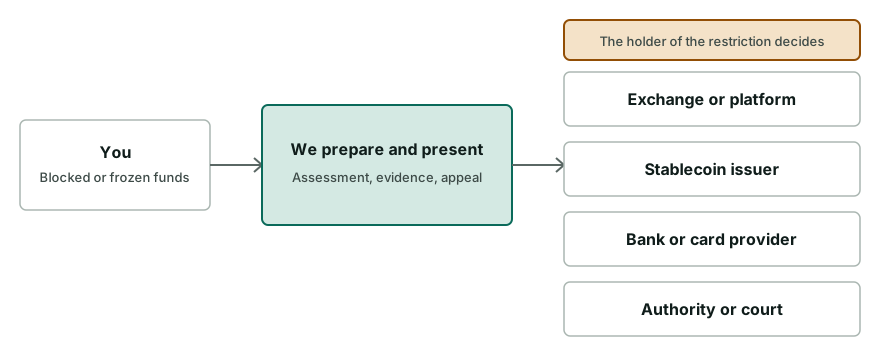
If you want help preparing your evidence, tracing the funds or sending freeze requests, you can ask us for a free assessment. You get a written answer on whether we can help before any fee is mentioned. We cannot make an authority or a platform act, and we never ask for a seed phrase, private key or password.
Common questions
Do I need to report if I lost only a small amount?
Reporting is your choice, but it can help. The FBI's IC3 says to file even when you lost no money. A report adds to the picture that authorities build across many victims, and it gives you a reference number that banks and exchanges often ask for.
Should I report to the police or to the exchange first?
Do both on the same day. The order matters less than speed. The exchange can look at funds it still holds, and the police can issue a reference number and may send formal requests to platforms. Keep each reference number.
Does it cost anything to report a crypto scam?
Taking a report is normally free, and IC3 says real law enforcement does not charge for its services. Treat any request for payment to file, speed up or 'unlock' a report as a scam warning.
My country is not in the table. Where do I report?
Start with your national police and, if your country has one, a national fraud or cybercrime reporting centre. Ask your bank which channel it recommends. Find the address on a government website that you type yourself, not through a link someone sent you.
Will reporting get my crypto back?
Usually not on its own. A report starts a record and may reach a platform that can act, but crypto transfers are hard to recover once sent, and no authority or provider can promise a result. Reports still matter as evidence, for banks and for other people who may be targeted.
How we can help
- Crypto scam recovery support. Calm help after a crypto scam: assess, document, trace and send freeze requests.
- Stolen crypto tracing and freeze requests. Trace stolen crypto, send freeze requests to exchanges and issuers, file a police report.
- Digital evidence preparation for crypto cases. Capture, log and organise chats, screenshots and records so police, platforms or lawyers can use them.
- Regulator complaints and ombudsman filings. Prepare a structured regulator, ombudsman or consumer complaint with a clear chronology.
Sources
Official or authoritative pages this page is based on. Pages change, so check the source for the current wording.
- Crime information: Cryptocurrency · FBI Internet Crime Complaint Center (IC3)
- Cryptocurrency fraud: how to report · Report Fraud (City of London Police)
- Reporting cybercrime and fraud · Canadian Anti-Fraud Centre
- Report a scam · Scamwatch, National Anti-Scam Centre (Australia)
- Filing a criminal complaint with the police (consumer centre guide, in German) · Verbraucherzentrale
- Online complaints office (in Spanish) · Policía Nacional (Spain)
- Consultation window for cyber incidents (in Japanese) · National Police Agency (Japan)
- Reporting economic crimes · UAE Government portal (u.ae)
Information on this page is general and not legal advice.