
Funds stuck in a smart contract or sent by mistake: what can realistically be done
Published: Last reviewed: Editorial policy
A confirmed blockchain transfer cannot be reversed by anyone, so funds sent to the wrong address or locked in a faulty smart contract come back only if someone with control agrees to act. That can be a protocol team with an admin function, an exchange that owns the receiving address, or the owner of a wallet. We check the options, contact the right party and document the case.
Questions about your case? Message us:
This is for you if
- You sent tokens to the wrong address, the wrong network or the token's own contract address
- Your funds are locked in a contract that no longer lets you withdraw
- A protocol bug or exploit affected your deposit and the team has said little
- You run a small project and users lost funds through a fault in your contract
- You want an honest answer on whether a return is possible before you spend more money
Typical situations
- Tokens sent on the wrong network to an address that also exists on another chain
- Coins sent to a token's contract address instead of a wallet address
- A staking or vesting contract that does not release tokens after an upgrade or a pause
- A protocol exploit drained a pool that held your deposit
- A typo or a lookalike address, where the receiver turns out to be a real wallet owned by someone else
- A failed transaction that still took the fee and left you unsure where the assets are
- A deposit to an exchange address that does not support the token you sent
What we do
- Establish exactly what happened on-chain
We read the transaction on a block explorer with you: sender, receiver, network, token, contract and status. Some cases that look lost turn out to be pending, on another chain or sitting at an exchange address.
- Find out who, if anyone, controls the destination
We check whether the receiving address is a personal wallet, an exchange deposit address or a smart contract, and who could act on it. This decides whether any route exists at all.
- Review the contract with independent specialists
Independent smart contract engineers read the code and its permissions: admin keys, pause or rescue functions, upgrade proxies and timelocks. They tell you in writing whether any path to a return exists and who would hold it.
- Approach the right party in writing
We prepare a short, factual message for the protocol team, exchange support, bug bounty channel or the owner of the receiving address. It includes hashes, addresses and a clear request, and it goes through official channels only.
- Coordinate claims and legal options
If the counterparty is identifiable and the amount justifies it, an independent lawyer can advise on a claim or a demand letter. Where a protocol runs a compensation plan, we help you file a claim with proof of your holding.
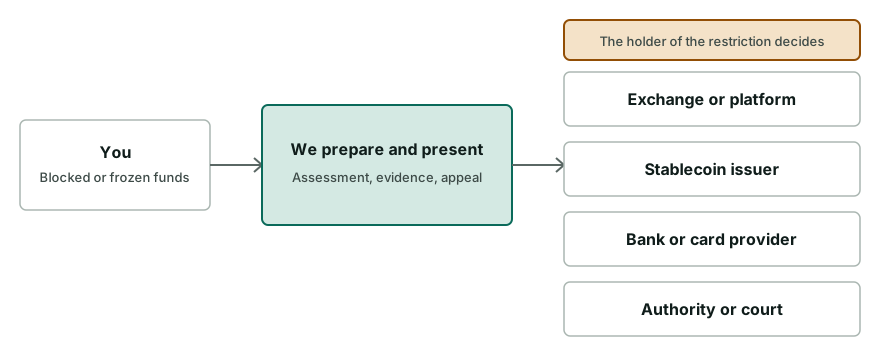
How the case runs
- Free assessment
Send us the transaction hashes, the network and a few lines on what you expected to happen. We reply in writing on whether any route looks possible or whether the funds are, in effect, final.
- Written scope and fee
If there is something worth trying, we send the scope, the specialists and the fee model before you pay. If not, we say so and the matter ends there at no cost.
- On-chain and contract review
We map the transfer and the specialists review the contract code and permissions. You receive a plain summary of who can act and who cannot.
- Contact and claim
We send the written approach to the party that can act and track every reply. You get copies of what we send and what comes back.
- Outcome note
We close with a short written summary of what was tried and what the result was. If no route remains, we say so plainly and do not keep the case open.
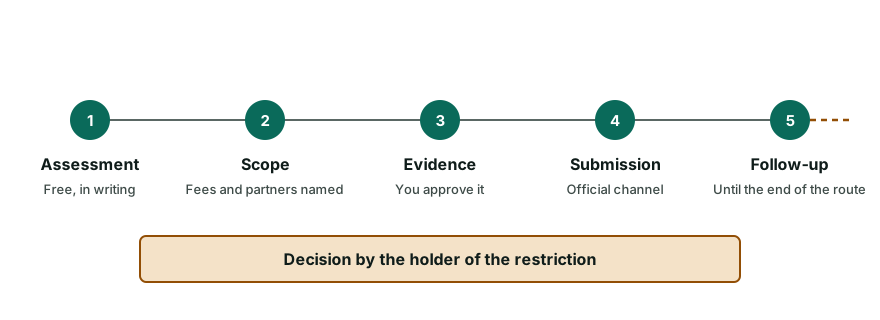
What to prepare
- Transaction hashes, with the network named, for every transfer involved
- The sending wallet address and the receiving address or contract address
- Screenshots of the app, website or exchange screen where the problem appeared
- The token name, its contract address and the official website or documentation
- Messages with support teams, project channels or the receiver, if any
- Proof that you control the sending account, such as an exchange statement, but never a seed phrase or key
- A short timeline of what you intended and what happened
What we cannot do
- Confirmed on-chain transfers are final. We cannot reverse, cancel or edit a transaction, and nobody else can either.
- Most cases depend on a protocol team, an exchange or the receiving party agreeing to help. We cannot force them, and they decide whether to act.
- We do not promise a return. In many cases the honest answer is that the funds are gone, and we say so early, before you spend more.
- We do not exploit bugs, attack contracts or move funds out of contracts you do not own. That is illegal in many places and would harm your case.
- Everything we do uses public data, so we never ask you for a seed phrase, a private key or a password.
How long it takes
The on-chain check is quick when you have the hashes. Everything after that depends on the other party: a protocol team, an exchange or an address owner may reply in days, in months or not at all. We update you as replies arrive.
Fees
The assessment is free and tells you whether any route exists. If we can go further, the scope and fee model arrive in writing before you pay, and the contract review by independent specialists is quoted as a separate item so you can stop at any step. Fees →
Questions people ask
Can I get crypto back if I sent it to the wrong address?
Only if the person or service that controls that address agrees to send it back. The network cannot reverse a confirmed transfer. If the address belongs to an exchange, its support team may help. If it is a private wallet with an unknown owner, there is usually no route.
I sent tokens on the wrong network. Are they lost?
Not always. If the address exists on the other network and an exchange or wallet provider controls it, they may be able to recover the funds, sometimes for a fee. If nobody controls that address on that network, the funds are usually stuck for good.
What if I sent tokens to the token's own contract address?
These are very hard to retrieve. Many token contracts have no function to release stray tokens, so the balance stays there. Some projects add a rescue function or can act through governance, so it is worth reading the code and asking the team.
Can a developer fix a bug and return my funds?
Sometimes. If the contract is upgradeable or has a pause or rescue function, the team that holds those keys may be able to act, and some protocols run compensation plans after an exploit. A contract that cannot be changed cannot be fixed by anyone.
Can you hack the contract to get my funds out?
No. Exploiting a contract is illegal in many places and can create new losses. Anyone who offers it is likely to be a scammer. We use lawful routes only: reading code, contacting the right party and, where useful, advice from an independent lawyer.
Do you need my seed phrase to look at my wallet?
No. Everything we do uses public information such as hashes and addresses. A real specialist never needs your seed phrase or private key. If someone asks for them, stop and treat the request as a scam.
Related situations
- DeFi exploit and bridge hack response. Tracing, alerts and reporting after a DeFi exploit, bridge hack or malicious approval.
- Blockchain analytics report. A source-of-funds report from transaction tracing, ready for a compliance team.
- Stolen crypto tracing and freeze requests. Trace stolen crypto, send freeze requests to exchanges and issuers, file a police report.
Read next
Sources
Official or authoritative pages this page is based on. Pages change, so check the source for the current wording.
- Introduction to smart contracts · ethereum.org
- Upgrading smart contracts · ethereum.org
Information on this page is general and not legal advice.