
AML compliance for crypto businesses: policies, risk assessment and programme review
Published: Last reviewed: Editorial policy
A crypto business needs an anti-money laundering (AML) programme that fits its own risks: a written risk assessment, policies, customer checks, screening, monitoring, records and training. We coordinate independent compliance specialists who help you build or review that programme. We are not a regulated auditor, a licensed money laundering reporting officer or a law firm, and we cannot promise what any regulator or bank will decide.
Questions about your case? Message us:
This is for you if
- Founders of a crypto start-up who must set up AML policies before talking to a regulator, a bank or a payment partner
- Compliance officers who want a second pair of eyes on a policy set or a risk assessment
- Finance and operations leads whose bank or payment partner asked for AML documents
- Teams that grew fast and now run on copied templates that no longer match their products
- Owners preparing for an audit, a partner review or questions from a regulator
Typical situations
- A bank or payment provider asked for your AML policy, risk assessment and a description of your controls
- You launched a new product, such as staking, a new token listing or a new country, and the risk assessment is out of date
- Customer onboarding is slow or inconsistent because the KYC procedure is unclear
- Alerts from screening or monitoring tools pile up with no written rules for handling them
- A regulator or auditor raised findings and you need a plan to address them
- Your policy was copied from a template and nobody has checked that it fits what you do
- A new compliance officer has joined and needs a structured handover
What we do
- Understand your business and its risks
We start with your products, customers, countries, payment methods and technology. A short fact sheet and a few interviews show the specialists which risks really apply, so the programme fits your business and not a generic template.
- Draft or review the risk assessment
Specialists help you write a business-wide risk assessment that rates customer, product, geography and delivery risks and ties each rating to a control. Where one exists, they review it for gaps, stale assumptions and missing evidence.
- Review policies and procedures against practice
We compare your written policies for onboarding, screening, monitoring, record keeping and escalation with what staff actually do. You get the gaps in plain words and an action list. Your lawyer confirms which legal rules apply to you.
- Help you choose tools
We help you write requirements for KYC, sanctions screening, blockchain analytics and case management tools, compare options against them and plan a trial. The purchase decision and the contract stay with you.
- Prepare your team and your answers
We prepare short briefings for staff and a list of questions a bank, auditor or supervisor is likely to ask, with draft answers built from your own documents. You remain the owner of every answer.
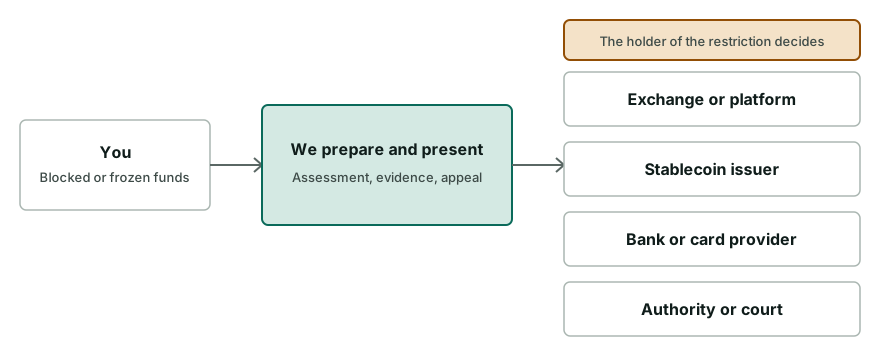
How the case runs
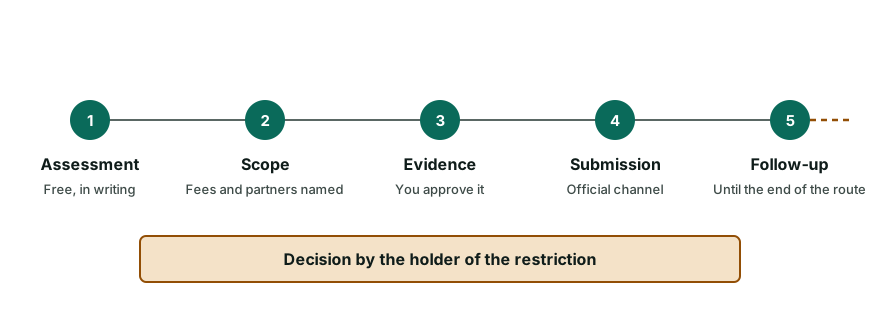
- Free assessment
You tell us what the business does, who asked for what and why. We say in writing whether independent compliance specialists can help and what they would need to see.
- Written scope and fee
You receive the scope, the proposed specialists, the deliverables and the fee model in writing before you pay. We agree what is in and out of scope.
- Fact-finding
Specialists read your documents and speak to your team. You get a list of questions and a date for answers.
- Draft deliverables
Specialists produce draft documents or a gap report. We check them for clarity and fit with your facts, then walk your team through them.
- Handover
You receive final versions, an action list with owners and a note on what remains open. Ownership of the programme stays with your named compliance officer.
What to prepare
- A short description of your products, services, customer types and countries served
- Existing AML, KYC, sanctions and monitoring policies, even if they are drafts
- Your latest risk assessment, if any, and the date it was last updated
- An organisation chart showing who holds compliance, management and board roles
- Samples of onboarding forms and alerts, with personal data removed
- The vendors you use for KYC, screening and analytics, and what each is used for
- Questions, findings or letters from a regulator, auditor, bank or payment partner
- Licence or registration details, if you hold any
What we cannot do
- We are advisers, not a regulated auditor, a licensed money laundering reporting officer or a law firm. We give no legal advice and we do not certify compliance.
- We do not act as your compliance officer, decide on your customers or file reports with any authority for you. Those duties stay with you.
- We cannot force a regulator, bank or auditor to accept your documents or reach a particular view, and we do not promise a licence, an account or an approval.
- A review we coordinate is advisory. It does not replace an independent audit or any review the law requires from a qualified party.
- We never ask for your seed phrase, private keys or passwords, and we do not need access to customer wallets or funds.
How long it takes
Time depends on the size of the business, the number of products and how quickly your team answers questions. A focused review takes less time than a full policy set. We agree the dates in the written scope and tell you early if something slips.
Fees
The assessment is free. After it we quote the scope and fee model in writing, with the independent specialists' fees shown separately. Nothing is charged until we have said whether we can help and you have accepted the scope. Fees →
Questions people ask
What does an AML programme for a crypto business include?
Typically a business-wide risk assessment, written policies, customer due diligence, sanctions and address screening, transaction monitoring, record keeping, staff training and a named person responsible. The details depend on your products, customers and the rules that apply to you. Your lawyer confirms those rules.
Can you act as our compliance officer or MLRO?
No. We are not a licensed officer and we do not take on that role. Your business keeps its own named compliance officer, who owns decisions and filings. Independent specialists can support that person with reviews, drafts and training.
Can you promise that we will pass a regulator's review?
No. Regulators, banks and auditors decide for themselves. We can help you put clear, consistent documents in front of them and prepare answers to likely questions. We cannot promise approval or any particular view.
Which rules apply to my business?
That depends on where you operate, which services you offer and who your customers are. We do not give legal advice on this. Your lawyer or the supervisor's own guidance confirms the rules, and the specialists then map your documents to the list you give them.
How is a programme different from a template?
A template gives you headings. A programme also needs a risk assessment that reflects your actual products and customers, controls that staff really follow and records that show they did. We review your documents against how the business works.
Do you need access to our customer data?
Not at the start. Specialists work from policies, process descriptions and samples with personal data removed. If a review needs real records, that is agreed in writing first, and access is limited to what the task requires.
Related situations
- Due diligence and risk assessment for crypto firms. Written, evidence-based checks on counterparties, customers and wallets, with a clear risk rating.
- Transaction monitoring advisory for crypto firms. Design scenarios, thresholds and alert procedures for on-chain and off-chain activity.
- Blockchain analytics report. A source-of-funds report from transaction tracing, ready for a compliance team.
- Wallet screening and risk flag disputes. High-risk address flag from screening tools: document the path of funds and challenge it.
Read next
Sources
Official or authoritative pages this page is based on. Pages change, so check the source for the current wording.
- Application of FinCEN's Regulations to Certain Business Models Involving Convertible Virtual Currencies (FIN-2019-G001) · Financial Crimes Enforcement Network (FinCEN)
- Cryptoassets: AML / CTF regime · Financial Conduct Authority
- Guidelines amending the ML/TF Risk Factors Guidelines (EBA/GL/2024/01) · European Banking Authority
Information on this page is general and not legal advice.