
Independent blockchain expert reports for court, arbitration and police files
Published: Last reviewed: Editorial policy
A crypto expert report for court is written and signed by an independent expert, not by us. The expert answers questions set with your lawyer, explains the method and states the limits. We coordinate the work: we help define the questions, brief the expert, prepare the exhibits and check the draft for clarity. We cannot promise that a court, tribunal or police unit will accept a report.
Questions about your case? Message us:
This is for you if
- Your lawyer needs a technical report on blockchain transfers for a claim, a defence or an arbitration
- You are a fraud victim and investigators or a prosecutor asked for a written analysis of the money trail
- A company must show a tribunal how funds moved between wallets, exchanges and counterparties
- A dispute turns on who controlled a wallet, when a transfer happened or where the funds ended up
- An earlier tracing report exists, but no one can explain its method to a judge
Typical situations
- A lawyer is preparing a civil claim over stolen crypto and must show the route of the funds
- A criminal complaint was filed and investigators want a technical summary to attach to the file
- The other side says a transfer did not come from your wallet or never reached theirs
- A contract for a token sale, mining services or custody is in arbitration over where the assets went
- A tracing report from a vendor is being challenged because its method is not documented
- A court wants a neutral person to explain how a blockchain transaction works
- The other side filed an expert report and your lawyer needs an independent review of it
What we do
- Define the questions with you and your lawyer
We help turn the problem into precise questions an expert can answer, such as which transfers, between which dates and addresses. We agree the scope with your lawyer, because the instructions given to an expert often carry legal weight.
- Find and brief an independent expert
We propose independent blockchain forensic experts and check availability, conflicts of interest and relevant background before you decide. We pass on the facts and documents. We do not tell the expert what to conclude.
- Prepare the material the expert relies on
We organise transaction hashes, exchange exports, bank records and screenshots into an indexed bundle that records where each item came from and when it was captured. Gaps are flagged early, so the expert is not left to guess.
- Review the draft for clarity
We read the draft as a non-technical reader would. We check that dates, amounts and addresses match your documents, that the method is explained and that limits are stated. Any substantive edit stays with the expert.
- Coordinate delivery and follow-up questions
We plan delivery around your lawyer's deadlines, pass on written questions from the court or the other side and help the expert answer them. If a hearing needs the expert, we help with the logistics.
How the case runs
- Free assessment
You tell us what the report is for, who asked for it and when it is due. We say in writing whether an expert report is the right tool or whether a simpler analytics report would do.
- Written scope and fee
If you proceed, you receive the questions, the proposed expert, the expert's fee basis and our fee model in writing. Work starts only after you accept them.
- Instruction and evidence bundle
Your lawyer or you instruct the expert in writing. We deliver the indexed bundle and answer the expert's requests for missing records.
- Draft and review
The expert sends a draft. We check it for clarity and consistency with your documents and pass questions back to the expert, who decides whether to change anything.
- Final report and follow-up
The expert signs and issues the final report to you or your lawyer. We stay available for later questions, replies from the other side and hearing arrangements.
What to prepare
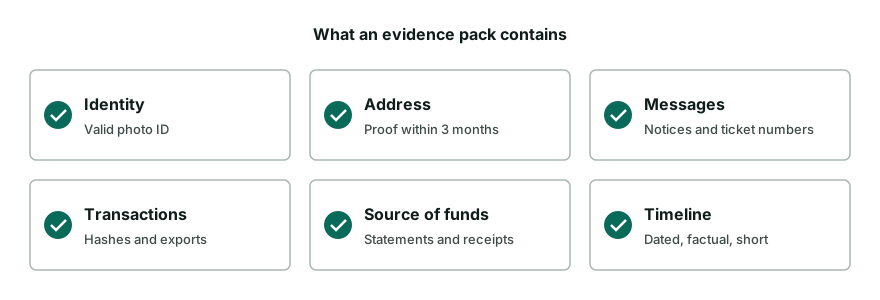
- The claim, complaint, order or letter that explains why the report is needed
- Your lawyer's name and contact details, and any deadline they have given you
- Wallet addresses and transaction hashes in scope, with a note on which wallets you control
- Exchange exports, bank statements and receipts for the period
- Chats, emails and contracts that explain the purpose of the transfers
- Any earlier analysis, police report number or screening result
- A list of the people and companies involved, so the expert can check for conflicts
What we cannot do
- We are not an expert witness and we do not sign opinions. The independent expert alone forms, writes and signs the conclusions.
- We cannot make a court, tribunal, arbitrator or police unit accept a report. Whether a report is admitted, and how much weight it gets, depends on the jurisdiction and on the judge or panel.
- We do not promise a particular finding. An independent expert may reach a conclusion that does not help your case, and we pass it on unchanged.
- We are not a law firm, and legal advice comes only from your lawyer, who also decides how the report is used.
- An expert report needs only public addresses and your records, so we never ask for a seed phrase, private keys or passwords.
How long it takes
A court report takes longer than a short analytics summary, because the expert must document method, sources and limits. The time depends on how many addresses are in scope and on your court deadlines. We discuss realistic dates after the assessment, before you commit.
Fees
The assessment is free, and we say whether we can help before any fee is discussed. The expert's fee basis and our coordination fee are quoted in writing and shown separately, before you commit. If the expert must attend a hearing, that is quoted as its own item. Fees →
Questions people ask
What is the difference between an expert report and an analytics report?
An analytics report explains the path of funds for a compliance reader. An expert report is written for proceedings. It states the questions asked, the expert's independence and method, the facts relied on and a reasoned opinion, and the expert can be questioned on it.
Will a court accept a blockchain expert report?
We cannot say. Rules on expert evidence differ by country and by court, and the judge decides what weight to give a report. A clear method, source records and an impartial expert help. Your lawyer should confirm the requirements for your forum.
Can you write the report yourselves?
No. The report must come from an independent expert who forms and signs the opinion personally. We organise the work, prepare the materials and check the draft for clarity. We do not write or change the conclusions.
Do I need a lawyer to get an expert report?
For court or arbitration, almost always. Lawyers usually instruct experts, know the formal requirements and decide how a report is used. If you do not have one, we can introduce independent licensed lawyers, who act under their own engagement.
Will the expert have to attend a hearing?
Sometimes. A court or the other side may ask the expert to explain the report or answer questions in person or by video. We agree this in advance and quote attendance separately. The expert answers independently and is not your advocate.
What if the expert finds something that hurts my case?
The expert reports what the records show, and we pass the finding to you or your lawyer unchanged. You then decide with your lawyer what to do. We do not ask an expert to change a finding, and an honest expert would refuse.
Related situations
- Blockchain analytics report. A source-of-funds report from transaction tracing, ready for a compliance team.
- Digital evidence preparation for crypto cases. Capture, log and organise chats, screenshots and records so police, platforms or lawyers can use them.
- Stolen crypto tracing and freeze requests. Trace stolen crypto, send freeze requests to exchanges and issuers, file a police report.
- Crypto frozen by authorities. Assets held by authorities: we coordinate independent licensed lawyers. No legal advice.
Read next
Sources
Official or authoritative pages this page is based on. Pages change, so check the source for the current wording.
Information on this page is general and not legal advice.